
Ape index calculator
Your arm span against your height, as a difference and as a ratio. Then what to train, whatever the number says.
Does it matter?
Less than the forums make out. In a study of 44 sport climbers, training explained about 59% of the difference in grade between them. Body measurements, arm span among them, explained less than 1%.
What changes how far you reach on the wall is technique, and it can be trained:
- Build twist-lock moves: turning a hip into the wall adds reach on every move.
- High feet: the higher your foot, the higher you can reach.
- Deadpoint training and Jump into lock-off, for holds just out of reach.
- Dyno practice, for the ones well out of reach.
Long arms make cramped, compressed moves harder. Those take body tension, which starts with keeping your feet on.
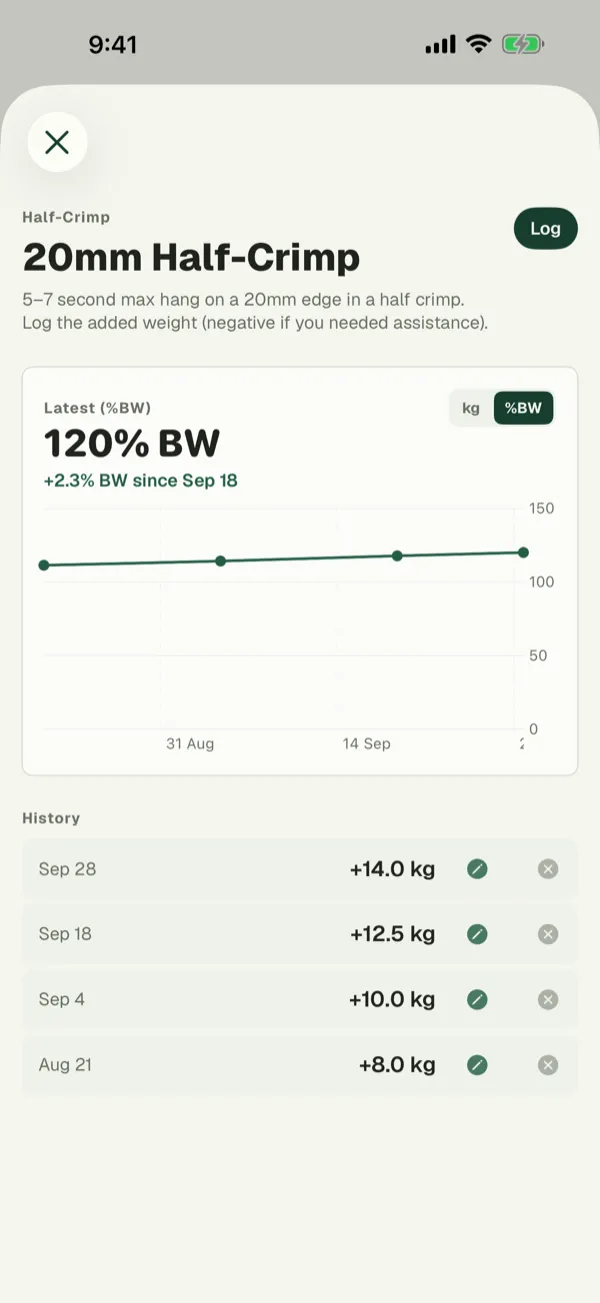
In the Blok Sessions app
Track the numbers that do move your grade
Finger strength and pulling strength are what training changes. Blok Sessions has five benchmark tests, among them a 20 mm half crimp hang and a max 2-rep pull-up, each shown as a share of bodyweight over time. Add tests of your own too.
Get it on the App StoreOr plan in your browser
Planning and logging are free with an account. See what Pro adds.
Questions
What is ape index?
Your arm span measured against your height. Written as a difference, +4 cm means your arms span 4 cm more than you are tall. Written as a ratio, the same climber is about 1.02. This calculator shows both.
How do I measure my arm span?
Stand with your back to a wall, arms straight out to the sides at shoulder height, palms forward, and have someone measure from fingertip to fingertip. Measure your height barefoot against the same wall.
What is a good ape index for climbing?
There isn't one to aim for. A long span helps on big moves between holds far apart; a short one can help on cramped, compressed moves. In a study of 44 sport climbers, body measurements explained less than 1% of the difference in grade, and training explained about 59%.
Can you change your ape index?
Not as an adult. You can change how far you reach on the wall, though: hips close to the wall, high feet, a twist into the wall and moving dynamically all add reach.
Find out what's stopping you
Seven questions about your climbing, then a plan built from your answers. Free.
Seven questions · about a minute