How to keep your feet on steep boulders without endless core workouts
Practise it on the wall, twice a week. Give 20 to 25 minutes of a session to steep boulders at your flash level and keep both feet on the whole way: push through your toes, pull with your heels, and climb each one 2 or 3 times with 2 minutes rest. Add toe hooks and heel hooks on a few moves. After climbing, spend 5 to 10 minutes on trunk work like dead bugs or hanging leg raises. That's enough core training for most boulderers, and how much extra off-wall core carries over to the wall is still debated.
“Why can’t I keep my feet on the wall?”
On steep ground your feet stay on because you hold them there. They cut loose when:
- they’re only resting on the hold, with nothing pushing into it or pulling back on it
- your hips drop away from the wall, so your weight swings out under your hands
- a move is near your limit and all your effort goes into your hands
- you’re tired, late in a session
Core strength helps with the second one. The rest comes down to how you use your feet, and you practise that on the wall.
Train it on the wall
Practise tension on steep boulders at a grade where you can think about your feet:
- Climb with full-body tension on overhanging flash-level boulders. Both feet stay on unless a move really forces them off.
- Toe hooks and heel hooks on easy steep moves. A foot that pulls is much harder to knock off than a foot that only stands.
- The toe-pull tension drill: hold a toe hook for 2 seconds with everything tight, then move one hand or foot without the other foot swinging off.
- Feet cut after every move, on big holds. It trains the moment after your feet cut, when you get them back on slowly and quietly.
Pick one or two per session and do them early, while you’re fresh. Two sessions a week with one of these in it is a good start.
How much core work you need
Off the wall, 5 to 10 minutes after climbing, twice a week, is enough.
- Dead bugs. Your lower back stays pressed down while your arms and legs move, which is what steep climbing asks of your trunk.
- Hanging leg raises. Knees to chest, slowly, without swinging, then straight legs once that’s easy.
- The L-sit, if you struggle with mantles as well.
The backs of your legs matter too. Heel hooks and toe pressure come from your hamstrings and glutes, and single-leg Romanian deadlifts train them with one light weight.
How much off-wall core training carries over to climbing is still argued about, which is one more reason to spend most of the time on the wall.
Where it goes wrong
- Drilling tension on your project. Near your limit you’ll cut loose to make the move, so drill it at flash level.
- Half an hour of planks. It tires you out for the climbing and trains a position you rarely hold on the wall.
- Leaving it to the end of the session. When you’re tired your feet cut on everything, and you end up practising the thing you’re trying to fix.
- Cutting loose on purpose everywhere. Some moves need your feet to come off, and most steep problems get easier with a foot left on.
Who this isn’t for
If your feet slip on vertical walls and slabs, the problem is usually how you place them. Work on precise, silent foot placements with quiet climbing first. And if a heel hook strains your hamstring or your knee, stop and see a physio before you drill it.
The exercises
Climb with full-body tension
5-6 flash-level overhangs, 2-3 times each, keeping both feet on the whole way.
Toe hooks
Practice toe hooks on 5-6 steep moves or features, 3 tries per side.
Heel hooks
Practice heel hooks on 5-6 easy steep moves, 3 tries per side.
Toe-pull tension drill
3-4 toe hook moves: pause 2 s in tension, then move one limb. 3 tries per side.
Feet cut after every move
5-6 easy steep boulders: let your feet swing off after every move, then replace them.
Dead bug
3 sets of 8 slow reps per side, lower back pressed down, 1 min rest.
Hanging leg raises / toes-to-bar
4 sets of 6-10 slow hanging leg raises, 90 s rest. Progress to toes-to-bar.
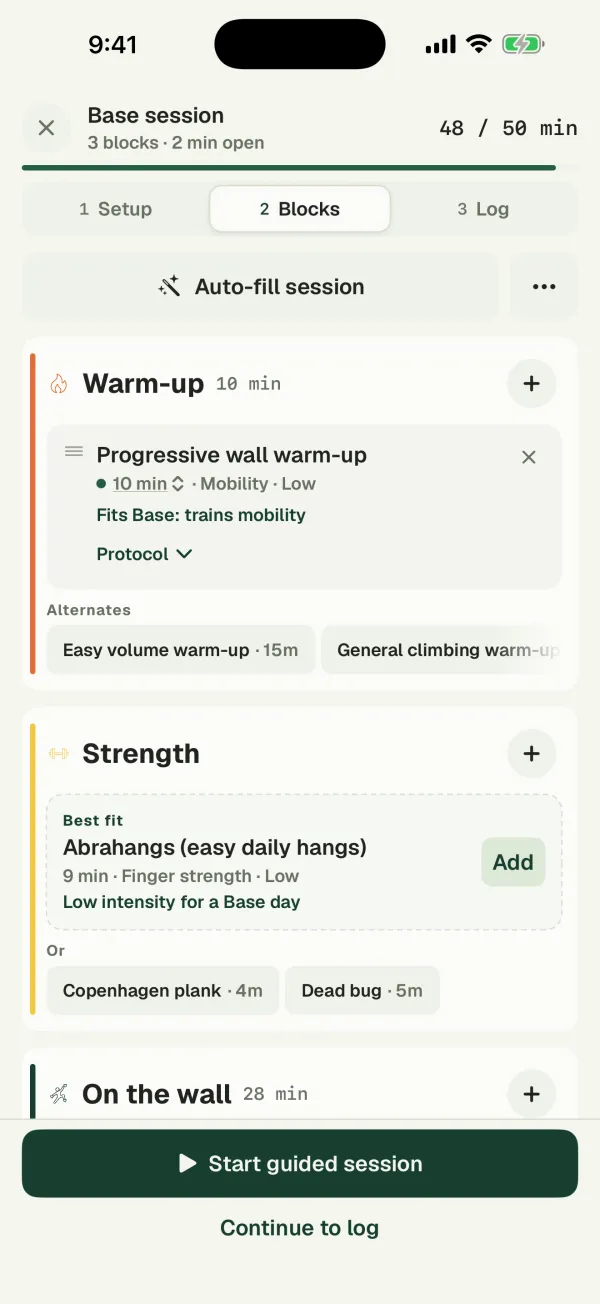
In the Blok Sessions session builder you add a tension drill for the wall and a few minutes of core work to the same session, and every exercise shows its minutes, so both fit the time you have.
Questions
Is it my core or my fingers?
Test it on a steep boulder two or three grades below your hardest. If your feet cut there, it's tension and technique. If they only cut on your hardest problems, your fingers are the limit, and your feet go when your hands run out.
Do planks help with climbing?
A little, as general trunk strength. They don't teach you to press through your toes or pull with a heel, and most of keeping your feet on is exactly that. Dead bugs and hanging leg raises are closer to what steep climbing asks for.
Do I need to train front levers?
No. Plenty of strong boulderers can't hold one. It's an advanced exercise with a high injury risk, so if you train it, do it after a full warm-up and stop at any pain in your shoulders or elbows.
Will board climbing fix it?
It helps, because a steep board punishes loose feet on every move. Use it the same way as the drills here, on problems you can climb with both feet on, a few grades below your hardest.