
How to retest your climbers at the end of a training block

Short answer
Repeat exactly the tests you ran at the start, in the same way: same edge, same hand position, same warm-up, same time of day, and after a light week or at least two easy days. Weigh them on the day and compare the load as a share of bodyweight. Look at the change next to what they logged during the block, and treat a small difference as no difference: one test on one day carries some noise. Then write the next block from what moved and what didn't.
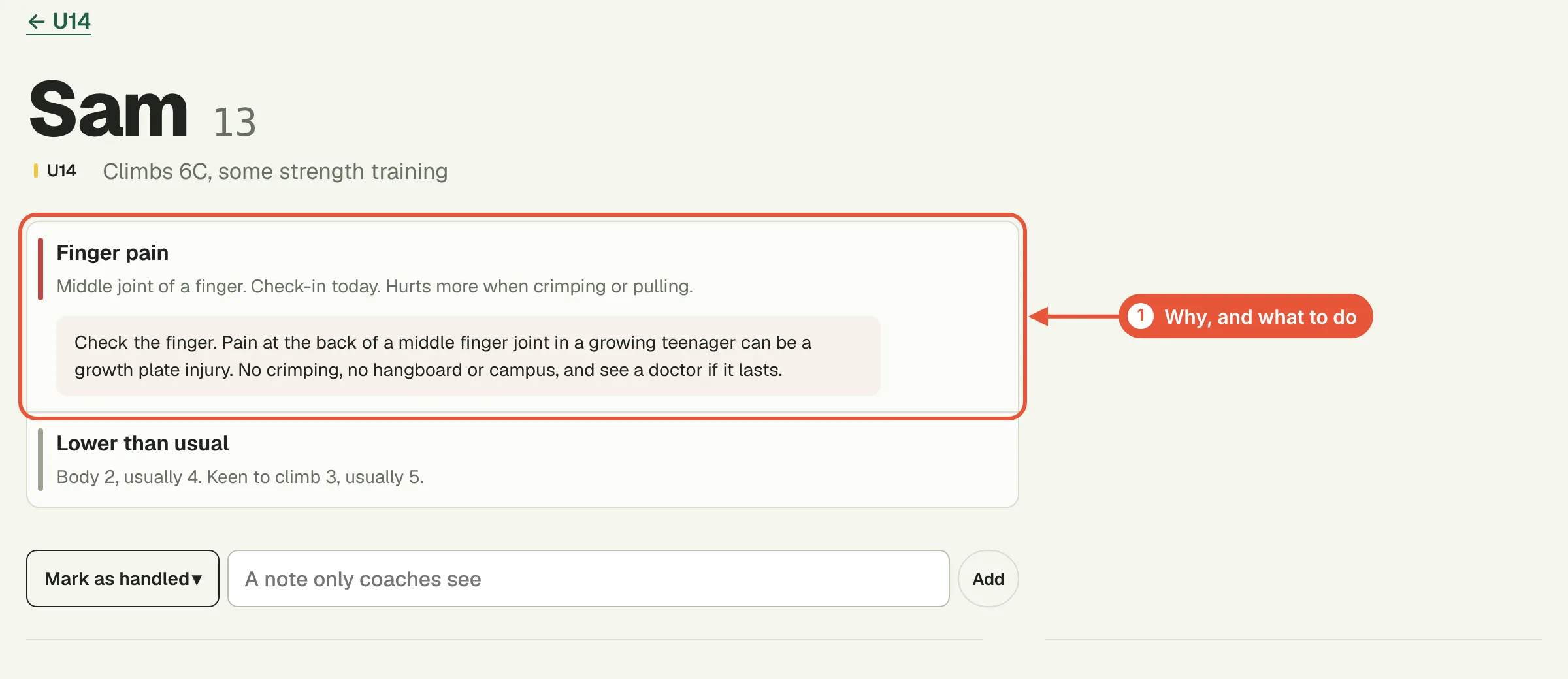
Coaching climbers? The coach area is free for up to 5 climbers: their plans, what they log and who has a sore finger, in one place.
See the coach areaKeep everything the same
A retest only tells you something if the only thing that changed is the climber. Write down how the first test went and repeat it exactly:
- the same edge, the same depth, the same hand position;
- the same warm-up, ending with a couple of easy hangs;
- the same time of day, and a similar day in the week;
- after a light week, or at least two easy days;
- bodyweight on the day, so loads compare as a share of bodyweight.
If the first test was on the gym's hangboard, don't retest on a home board. Edges differ more than people expect.
What to test
| Test | What it shows |
|---|---|
| 20 mm hang, half crimp | Max finger strength in the position most hard holds use |
| 20 mm hang, open hand | The same, kinder to the pulleys |
| 2-rep max pull-up | Pulling strength |
| Max hang for time | Finger endurance at bodyweight |
| Bodyweight | Makes the others comparable |
| A test of your own | What this block trained: a board benchmark, a circuit, a lock-off |
With a Tindeq Progressor the same tests give more: peak force, how fast they reach it, left against right, and critical force from a repeater test.
Read the change next to the training
- A clear rise after a strength block is what you planned for. Keep the next block's finger work similar and change the focus.
- No change after a block with good attendance: the dose was too low, too high or too short. Look at how many finger sessions they actually logged and how hard they rated them.
- No change and half the sessions missed: the plan didn't fit their week. Fix that before the load.
- A drop: check sleep, illness and a heavy last week before you blame the plan.
- Small differences either way are noise. Look for a change you'd still believe if you tested again.
Write the next block from it
Test results are where the next plan starts. Write down what moved, what didn't and what the climber noticed on the wall, and plan the next block around the weakest link.
Questions
Which tests should I use?
The ones you'll repeat. A hang on a 20 mm edge in half crimp and open hand, a 2-rep max pull-up, a max hang for time and bodyweight cover most bouldering blocks. Add a test of your own for what the block trained, like a board benchmark.
How often should climbers test?
At the start and end of each block, so every six to twelve weeks. Testing more often costs a hard session and the change between two close tests is mostly noise.
Should a climber test when they're tired?
No. Test after a light week or a couple of easy days, warmed up the same way as last time. A tired test shows fatigue, not strength.
Can I ask climbers to test without being there?
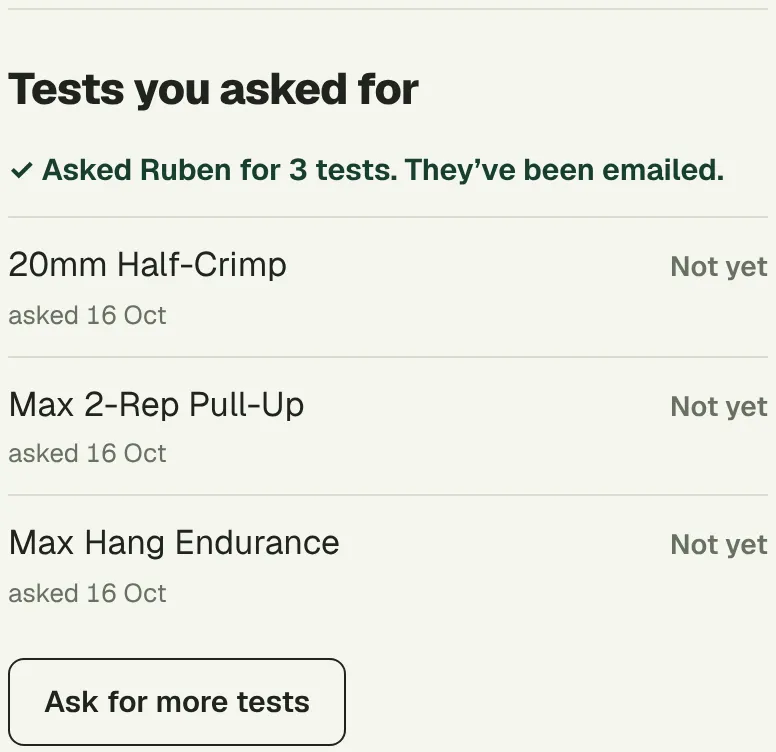
Yes. In the Blok Sessions coach area you ask a climber or a whole squad for tests, they log them in the app, and each one is ticked off on your side when it's done.
Coach your first 5 climbers free
Write each climber's plan, see what they log and read their check-ins before training. Paid plans start at €10 a month for up to 25 climbers.
Free for up to 5 climbers