
How to tell if your climbing training is working without guessing
Test, train, then test again the same way. Record a baseline on a few repeatable tests: a short max hang on a 20 mm edge in a half crimp and in an open hand, the most weight you can add for 2 strict pull-ups, and how long you can hang a comfortable edge. Retest every 4 to 8 weeks, fresh, after the same warm-up and on the same edge. Keep a short log of what you trained in between. If the numbers go up, it's working. If they're flat after two retests, change one thing.
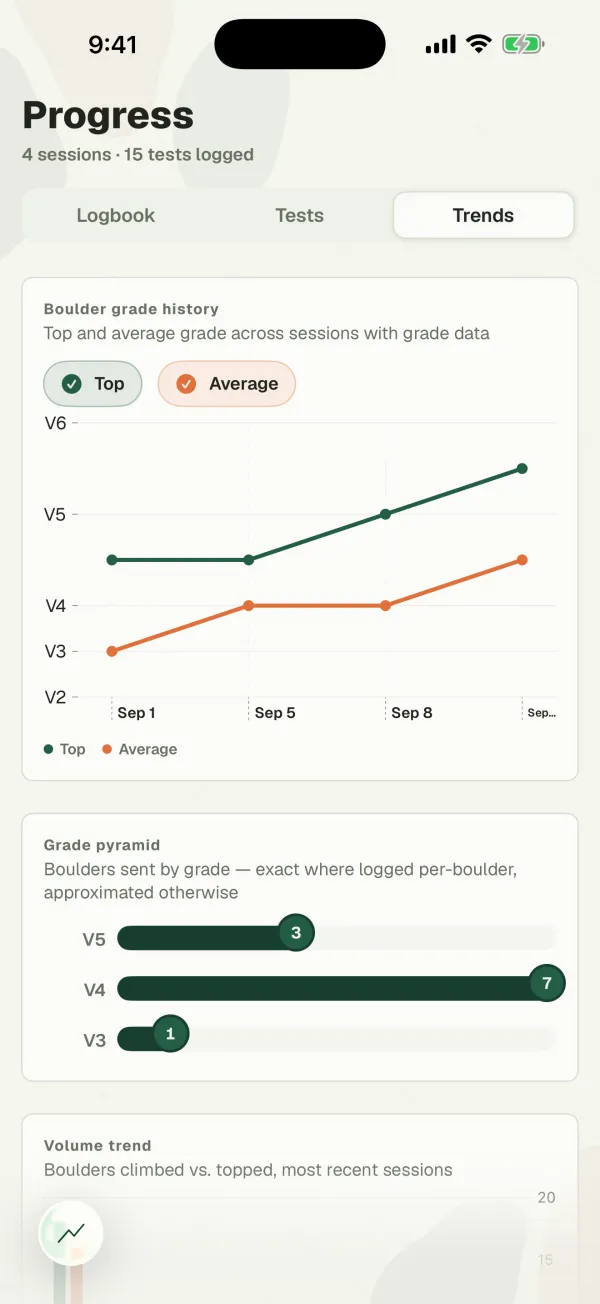
Blok Sessions has five benchmark tests with your history for each, and Trends shows your grade history, grade pyramid and training load per week. It's all free.
Start with the free six-week strength plan: a file for the app and seven short emails on how to run it.
Or start planning in your browser with a free account.
Why your grade isn’t the test
Grades are slow and noisy. Setters differ, styles differ, and so does how you feel on the day. Your grade can stay put for months while your fingers get stronger, or jump because a set suits you. Use grades for the long view and tests to check your training.
Five benchmarks worth tracking
| Test | What it tells you |
|---|---|
| 20 mm half crimp, 5 to 7 second max hang | Finger strength in the position most climbers test |
| 20 mm open hand, 5 to 7 second max hang | Finger strength in open positions |
| Max 2-rep pull-up | Pulling strength: the most weight you can add for 2 strict reps |
| Max hang endurance | How long you can hang a comfortable edge or jug at bodyweight |
| Bodyweight | Lets you read the hangs and pull-ups as a share of your weight |
For the hangs, log the weight you added. If you needed help from a pulley, log it as a negative number.
Test the same way every time
- Same edge. A “20 mm” edge on one board isn’t the same as on another, so only compare results from the same board.
- Same warm-up. Easy boulders getting harder, then a couple of submax hangs, like the boulder and hang ramp.
- Fresh. Not the day after a hard session. The end of a lighter week works well.
- Same order and full rests between attempts.
- Write it down straight away, with anything unusual: a new board, a bad night, sore skin.
How often to retest
Every 4 to 8 weeks. That’s common practice, not a number anyone has proved. Strength changes slowly, so a weekly test mostly measures how tired you are. A good rhythm is to retest at the end of a training period, before you plan the next one.
What else to track
Tests show strength. A log shows everything around it:
- what you trained each week, and for how many minutes
- boulders tried against boulders topped, and at which grades
- how often you send on the wall angles you usually avoid
- how each session felt, and any aches. A few lines of training reflection after each session are enough.
Reading the numbers
- Tests up, grade flat: strength isn’t your limit right now. Look at movement and tactics.
- Tests flat, grade flat: the training isn’t doing its job. Change one thing, like harder hangs or more time on limit boulders, and retest.
- Tests down and you feel tired: you probably need a lighter week, not more training.
- Grade up, tests flat: that’s fine. You’re climbing better.
Where it goes wrong
- Testing too often. You’ll chase noise and tire your fingers.
- Changing everything at once. If the numbers move, you won’t know why.
- Comparing with a friend who tests on a different board.
- Only logging the good days. The bad ones are where you learn what “too much” is.
The exercises
Boulder and hang ramp
Gradually harder boulders, then 2-3 submax hangs on a 20 mm edge, 2-3 min rest.
Training reflection
After a session, write what you trained, how your body took it, and one change to the training.
Goal setting
Write an outcome goal with a date, a process goal, one weekly habit, and this week's action.
Questions
How often should I test my finger strength?
Every 4 to 8 weeks, fresh and after the same warm-up. Testing more often mostly shows how tired you are, and a max hang is hard on your fingers, so don't make it a weekly habit.
What's a good 20 mm hang for my grade?
It varies a lot between climbers at the same grade, and edges differ from board to board. Compare with your own last result on the same edge. That tells you whether your training's working.
Is a max hang test safe for me?
Do it only if you've climbed regularly for a year or two and have no finger pain, and always after a full warm-up. Stop at any sharp pain in a finger. If you're newer than that, track how long you can hang a comfortable edge or a jug instead.
My grade went up but my tests didn't. Is that bad?
No. It usually means you're climbing better through movement, tactics or more time on hard climbs. Keep doing what you're doing and retest next time.
What should I write in a training log?
What you did, for how long, how hard it felt, and anything that felt off, like a finger ache. A few honest lines after every session are worth more than a detailed log you stop keeping after two weeks.