
How to boulder two days in a row without wrecking the second day
Make the first day hard and the second day easy. Day one is limit bouldering or a hard board session while you're fresh. Day two stays well below your flash grade: technique drills, slow and quiet climbing and easy traversing, with no limit moves and no hangboard. Keep hard finger days at least 48 hours apart and take a rest day after two days on. If you want a harder second day, build up to it over several weeks, and only while you still turn up fresh for your next hard session.
“How bad is it to climb two days in a row?”
Not bad at all, if one of the days is easy. Two easy days in a row is just climbing. The trouble starts with two hard days. The second one begins with fingers that haven’t recovered from the first, so you try the same hard moves weaker and your fingers take a heavy load twice with no break. That’s the day people tweak something, or go home feeling like they’ve got worse.
What counts as a hard day
Anything that loads your fingers close to their max, or leaves you wrecked:
- limit bouldering, or projecting at your limit
- a board session on problems near your limit
- max hangs or repeaters on a hangboard
- pump sessions like 4x4s
Count them together. A board session and a hangboard session on the same day make one hard day. A board session on Monday and hangs on Tuesday make two in a row.
What day two should look like
Easy enough that you’d feel fine doing it again tomorrow. Stay well below your flash grade and give the session a job that isn’t effort:
- A gentle warm-up that mixes mobility with easy boulders.
- A technique drill, like slow-motion climbing, or an easy skill bite with one rule, such as quiet feet.
- Something that keeps you moving: climbing with flow on easy problems, or an easy traverse where you could still hold a conversation.
- A forearm flush, so you finish less pumped than you started.
Leave the hangboard alone that day, and skip anything you’d call a project.
Hard day first, then easy
Put the hard session on the first day, straight after a rest day, when your fingers are fresh. The easy session the day after gets you moving without asking much of them.
The other way round works too, as long as the easy day really is easy. The version that goes wrong is a “moderate” first day that drifts into a hard one, followed by a limit session the next day.
Building up to more
If two days in a row already leaves you flat, keep the second day easy for now. Add training one step at a time:
- Start with the easy second day and keep it easy for a few weeks.
- Once you come into your next hard session as fresh as before, make day two a little longer, or climb a little closer to your flash grade.
- Keep two limit sessions a week as your cap. Three is for climbers who’ve trained for years, and never on three days in a row. Two on and one off is the common pattern.
When day two should be a rest day
Take the day off instead if your fingers feel stiff in the morning, your skin’s raw, or the first easy boulders feel heavy. If a finger hurts, see a physio before you train it again.
Who this isn’t for
If you only climb twice a week, don’t put the sessions back to back. Spread them out with two or three days between, like the week in two sessions a week, and give each one a job of its own. The free four-week plans come in 2, 3 and 4 days a week.
The exercises
Regeneration flow warm-up
Gentle mobility mixed with smooth, easy boulders. Stop before any pump.
Slow-motion climbing
6-8 boulders 2-3 grades below flash, as slowly and precisely as possible.
Easy skill bite
6-10 easy boulders with one rule: quiet feet, no readjusting, or steady breathing.
Climb with flow
4-5 easy boulders, 3 times each, linking moves with your hips without pausing.
Aerobic restoration traverse
Easy nonstop traversing in 10 min bouts, 2 min rest. Breathing stays conversational.
Forearm flush
5 bouts of 90 s very easy climbing, 30 s rest. Finish less pumped than you started.
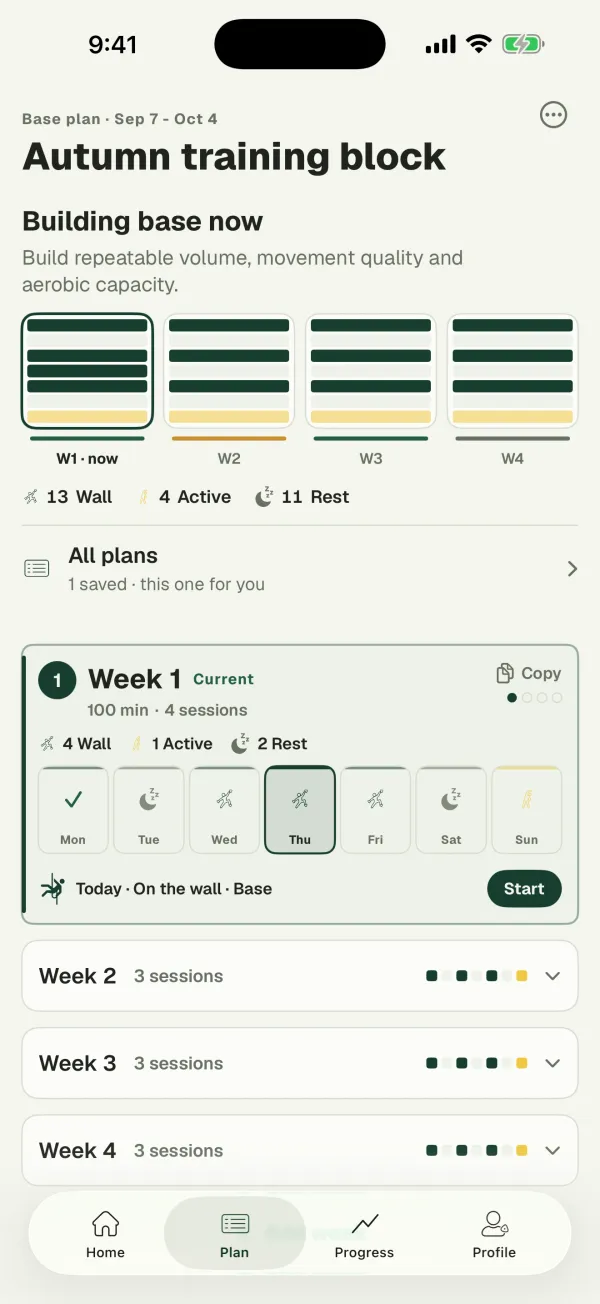
In Blok Sessions you lay out each week yourself, with wall, active and rest days, and every exercise shows its intensity, so the easy day after a hard one is planned before you get to the gym.
Questions
Is it bad to climb two days in a row?
No, as long as one of the two days is easy. What to avoid is two limit sessions or two hard finger sessions back to back. Keep those at least 48 hours apart.
Can I hangboard the day after a hard bouldering session?
Not max hangs or repeaters, which need 48 hours or more after other hard finger work. Easy feet-on hangs like Abrahangs, which should never feel hard, are fine on a rest day, at least 6 hours away from climbing.
Should the hard session be on the first day or the second?
The first, straight after a rest day, when your fingers are fresh. The other way round only works if the first day really is easy.
What about a trip, where I want to climb hard every day?
Try your hardest project on the first day, while you're fresh, and expect the second day to feel harder. Spend it on easier problems or a different style, and take a rest day after two or three days on.
How many hard days a week can I do?
Two limit sessions a week is the cap for most climbers, and three is for people who've trained for years. Never three hard days in a row. The other days are easy climbing or rest.