
How to take a deload week without losing your strength
A deload week is a planned lighter week: you still climb and train, but about half as much, and nothing at your limit. A common rhythm is three hard weeks, then one deload week. If you recover slowly, try two hard weeks and one lighter one. Keep your usual days but shorten the sessions, drop max hangs and limit bouldering, and fill the time with easy climbing, technique drills and mobility. You won't lose strength in a week, and you'll start the next hard week fresher.
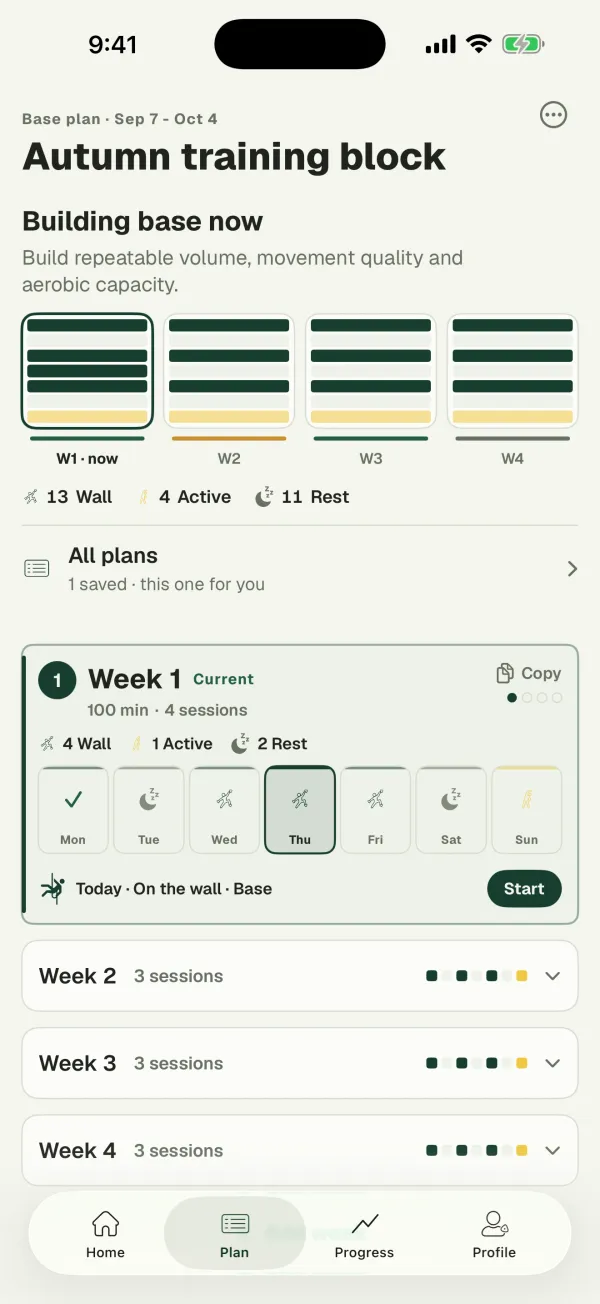
In Blok Sessions a plan is a run of training periods with Deload as one of them, and every exercise says which periods it's for, so a lighter week gets lighter exercises.
Start with the free six-week strength plan: a file for the app and seven short emails on how to run it.
Or start planning in your browser with a free account.
“Don’t feel like deloading? Do it anyway.”
Hard weeks stack up small bits of fatigue: fingers that feel stiff in the morning, flat sessions, worn skin, poor sleep. None of it stops you training, so you keep going. A lighter week lets it settle before it turns into a tweak or an illness that costs you a month.
There’s very little research on deload weeks for climbers. Coaches use them anyway, because a planned easy week is easier to live with than a forced week off with a sore finger.
How often to deload
- Three hard weeks, then one deload week. A good starting point for most climbers who train three or four days a week.
- Two hard weeks, then one. If you’re over 40, recover slowly, or work and sleep are eating into your recovery. A hard work week isn’t a rest week.
- Sooner than planned if you’re getting ill after hard weeks, you’ve felt flat for more than a couple of sessions, or your test numbers are dropping. If a finger hurts, that’s not a deload question: see a physio.
What to do in a deload week
| Keep | Cut |
|---|---|
| Your usual training days | About half the sets and minutes |
| Easy climbing, technique drills, mobility | Max hangs, repeaters, limit bouldering, campusing |
| Easy feet-on finger hangs | Anything to failure |
| Sessions you finish feeling fresh | Sessions that leave you wrecked |
A deload week might look like this:
- Day 1: a gentle regeneration warm-up, then quiet climbing on flash-level boulders.
- Day 2: Abrahangs and a mobility session at home.
- Day 3: a circuit climbed perfectly, or an easy traverse where you could still hold a conversation.
Technique drills fit a deload well. They need attention, not effort, and you’ll take the better movement into the next hard week.
“Won’t I lose strength?”
No. Strength you’ve built over weeks and months doesn’t disappear in seven days of lighter training. What goes down is fatigue. That’s why the end of a deload week is a good time to retest: you’re measuring your strength, not how tired you are.
Where it goes wrong
- Projecting “just one” hard boulder. One limit session turns a deload into a normal week with fewer days.
- Cutting intensity but adding volume. Three hours of easy mileage isn’t a lighter week.
- Skipping it because you feel strong. Feeling good in week three is normal, and it isn’t a reason to skip the lighter week.
- Coming back with a max session. Make the first hard session a moderate one, then build.
Who doesn’t need one
If you climb once or twice a week and rarely train at your limit, you probably don’t need a planned deload. An easier week when life gets busy does the same job.
The exercises
Regeneration flow warm-up
Gentle mobility mixed with smooth, easy boulders. Stop before any pump.
Quiet climbing
6-8 flash-level boulders with silent hands and feet. Restart if you make noise.
Execute a circuit perfectly
Repeat each circuit problem until it's perfect: no hesitation, no readjusting. 5-6 problems.
Abrahangs (easy daily hangs)
10 feet-on hangs of 10 s with 50 s rest, across six holds, from 70-80% down to 30-40% effort.
Aerobic restoration traverse
Easy nonstop traversing in 10 min bouts, 2 min rest. Breathing stays conversational.
Questions
How much should I cut in a deload week?
Roughly half your total training, mostly by doing fewer sets and shorter sessions. Nothing goes near your limit. If you normally climb four days, you can still go four times; each visit is just shorter and easier.
Can I still hangboard in a deload week?
Easy feet-on hangs, yes. Max hangs and repeaters, no. The point of the week is to let your fingers recover.
Is a week off the same as a deload?
Close enough when you need it. A deload keeps you on the wall, so your movement and skin stay used to climbing. A full week off is fine when you're run down or ill. Either way, make the first session back a moderate one.
Should I deload after a trip or a comp?
Yes. After you've peaked for a trip or a comp, a lighter week lets your fingers and shoulders recover before you start building again.
When should I retest my strength?
At the end of a deload week, when you're fresh, so the numbers show your strength and not last week's fatigue.