
What to ask climbers before training

Short answer
Ask five quick questions before each session: does anything hurt, and where; how did you sleep; how does your body feel; how's your head; and how much do you want to climb today. Use a 1 to 5 scale where 1 is always worst, make every question skippable, and never block a session on it. Compare each climber with their own usual answers, not with each other, and act on pain straight away: a sore finger joint changes today's session before warm-up starts.
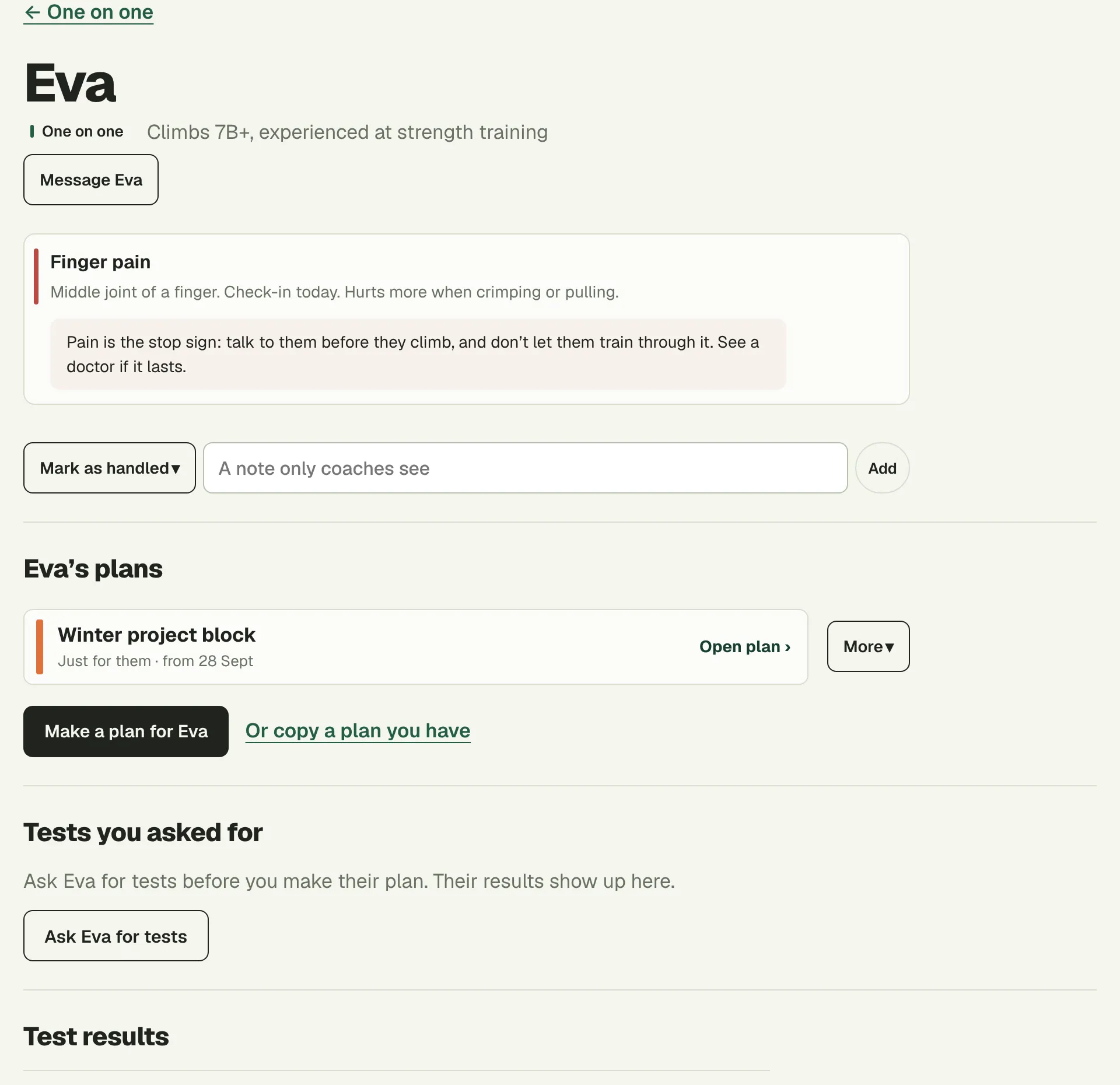
Coaching climbers? The coach area is free for up to 5 climbers: their plans, what they log and who has a sore finger, in one place.
See the coach areaThe five questions
| Question | Answer |
|---|---|
| Does anything hurt right now? Where? | No, a little, yes. If it does: which finger or joint, and does it hurt more when you crimp or pull? |
| How did you sleep last night? | 1 (terrible) to 5 (great) |
| How does your body feel today? | 1 (very tired or sore) to 5 (fresh) |
| How's your head today? School, work, stress. | 1 (stressed or low) to 5 (good) |
| How much do you want to climb today? | 1 (not at all) to 5 (really) |
Keep 1 as the worst answer on every scale, so a low number always means "not great" and nobody has to think about which way round it goes.
How to read the answers
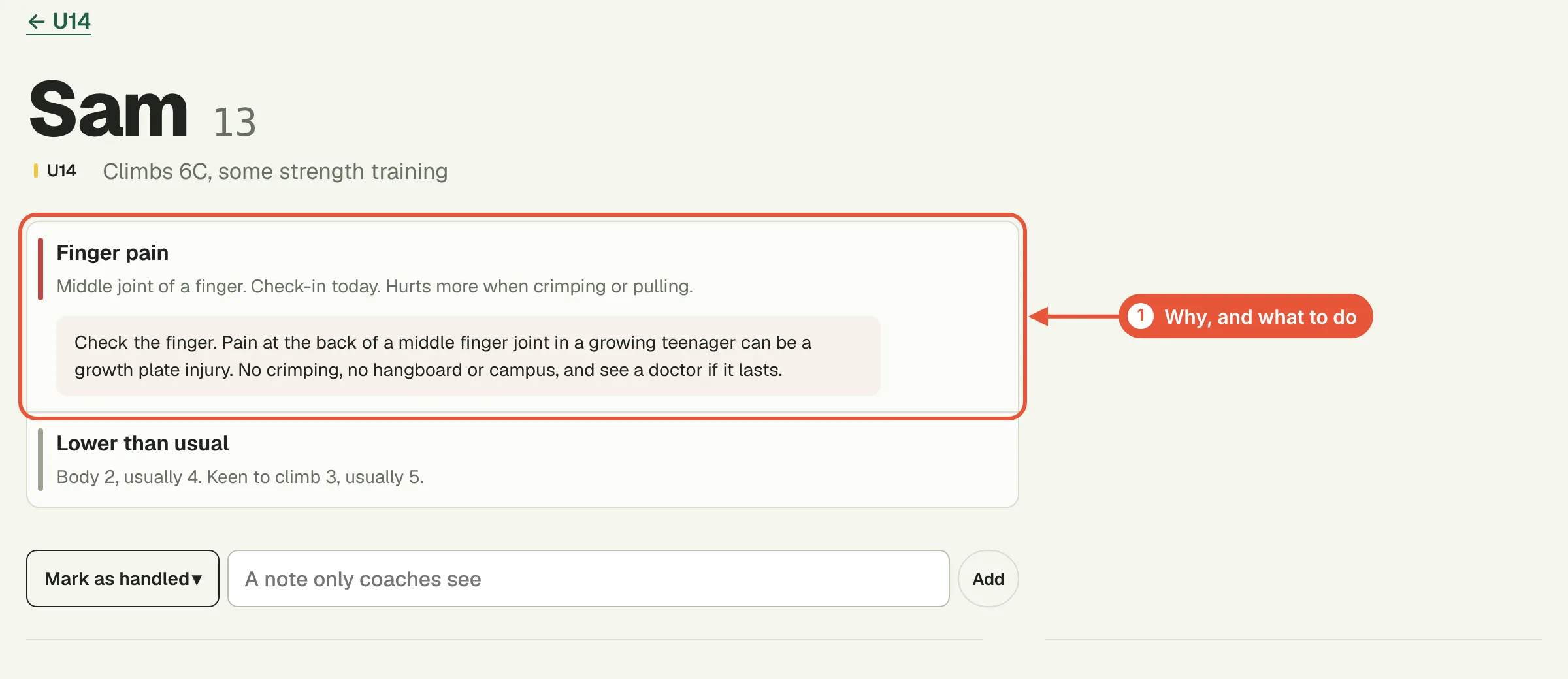
- Pain first. Any pain gets a conversation before warm-up. Pain at a middle finger joint in a growing teenager can be a growth plate injury: no crimping, no hangboard or campus, and a doctor if it lasts. Pain at the same joint twice in two weeks is a pattern, even if it's "a little".
- Against their own usual. One climber always sleeps a 3, another a 5. Look for a drop of two points from what's normal for them, not a low number on its own.
- More than one low at once. Bad sleep, a tired body and no wish to climb on the same day is the day to swap the hard session for an easy one.
- Next to their training. A run of low answers after a heavy week says the load went up too fast.
What not to do
- Don't add the answers up into one readiness score or rank climbers by it.
- Don't read stress or mood answers as a diagnosis of anything.
- Don't ask young climbers about weight or how heavy they feel.
- Don't make it a gate. A climber who skips the questions still trains.
After the session
One question: how hard was it, from 0 (rest) to 10 (as hard as it gets)? Times the minutes, that's their session load, a measure that holds up in research with young athletes too. Watch the weekly total against their own recent weeks; a big jump is worth a word even when the check-ins look fine.
Questions
Why before the session and not after?
Before is when you can still change the session. After, ask one question instead, how hard the session was from 0 to 10, which with the minutes gives you their training load.
Won't climbers get tired of answering every time?
They stop when nobody acts on the answers. Keep it to a few seconds, and let them see that a bad night or a sore finger changes what you ask of them that day.
Is this a medical screening?
No. It tells you what the climber reports so you can talk to them. It doesn't diagnose anything, and a climber with persistent pain needs a doctor.
How does the check-in work in Blok Sessions?
Climbers in a coach's squad see it on the app's Home screen before training. Every question can be skipped. Finger pain goes to the top of the coach's screen, with where it hurts.
Coach your first 5 climbers free
Write each climber's plan, see what they log and read their check-ins before training. Paid plans start at €10 a month for up to 25 climbers.
Free for up to 5 climbers