
How much antagonist training climbers need, without a second gym session
About 10 minutes, twice a week, at the end of a climbing session, so it never needs a gym visit of its own. Pick one pushing exercise, like push-ups with a plus at the top, and one for the back of your shoulders, like external rotations with a light band. Do 3 sets of each and finish every set with a few reps left. Swap in pike push-ups or finger opens against a band every few weeks. The evidence in climbers is thin: it's a reasonable bet for shoulders and elbows, and nobody has shown it prevents finger injuries.
“Is antagonist training really necessary?”
Climbing is almost all pulling and closing your hand. Antagonist training works the other direction: pushing, pressing overhead, turning your shoulder out and opening your hand. The idea is that your shoulders and elbows cope better with hard pulling when the muscles on the other side are strong as well.
The research in climbers is thin, and “it prevents injuries” goes further than anyone has shown. It’s low-risk and takes 10 minutes, which is why coaches often keep some of it in all year.
What 10 minutes looks like
Two short routines, one for each climbing day:
- Day A, about 10 minutes: push-up plus and band external rotation with your elbow up, in the arm position you climb in.
- Day B, about 11 minutes: eccentric triceps extensions with a band, in the position you use for mantles and gastons, and finger extensor band opens.
Alternate the two exercises in each pair. The rest after a set of one is when you do a set of the other, so 3 sets of each fit in the time.
Every few weeks, swap one for a harder push: pike push-ups, or dips if your shoulders are happy with them.
Where it goes in your week
- At the end of a climbing session, after the hard climbing and before you pack up. It adds no work for your fingers.
- On a rest day at home, if you left the gym without it.
- As part of your warm-up, lightly. The antagonist tissue prep gets your shoulders and wrists moving in 8 minutes.
Don’t do the working sets before limit bouldering or a board session, because tired shoulders make hard moves harder.
How hard it should feel
Easy to moderate. Stop every set with two or three reps left, and add reps before you move to a harder version. If you can still feel it on the wall at your next session, it was too much.
Where it goes wrong
- Turning it into a second gym session. An hour of chest day costs recovery your climbing needs.
- Skipping it for months, then doing a big session the week a shoulder feels off.
- Heavy bands on the shoulder exercises. Use one light enough that every rep stays slow and smooth.
- Treating it as rehab. For a sore shoulder or elbow, see a physio.
Who can skip it
If you already lift twice a week and your sessions include presses or push-ups, you’re doing it already. Keep the external rotations if your lifting has nothing for the back of the shoulder.
The exercises
Push-up plus
3 sets of 10-15 push-ups with a plus at the top: push the floor away so the shoulder blades spread.
Band external rotation (90 degrees abducted)
3 sets of 8 rotations per arm with a light band, elbow up at shoulder height, 1 min rest.
Eccentric triceps extension (band)
3 sets of 10 slow band lowers per arm, other arm reaching overhead, 3-5 s each, 1 min rest.
Finger extensor band opens
3 sets of 20-25 finger opens per hand against a light band, 30 s rest.
Pike push-ups
3 sets of 6-10 pike push-ups, 90 s rest.
Antagonist tissue prep
1-2 easy rounds of push-ups, band press-downs, wrist extensions, and external rotations.
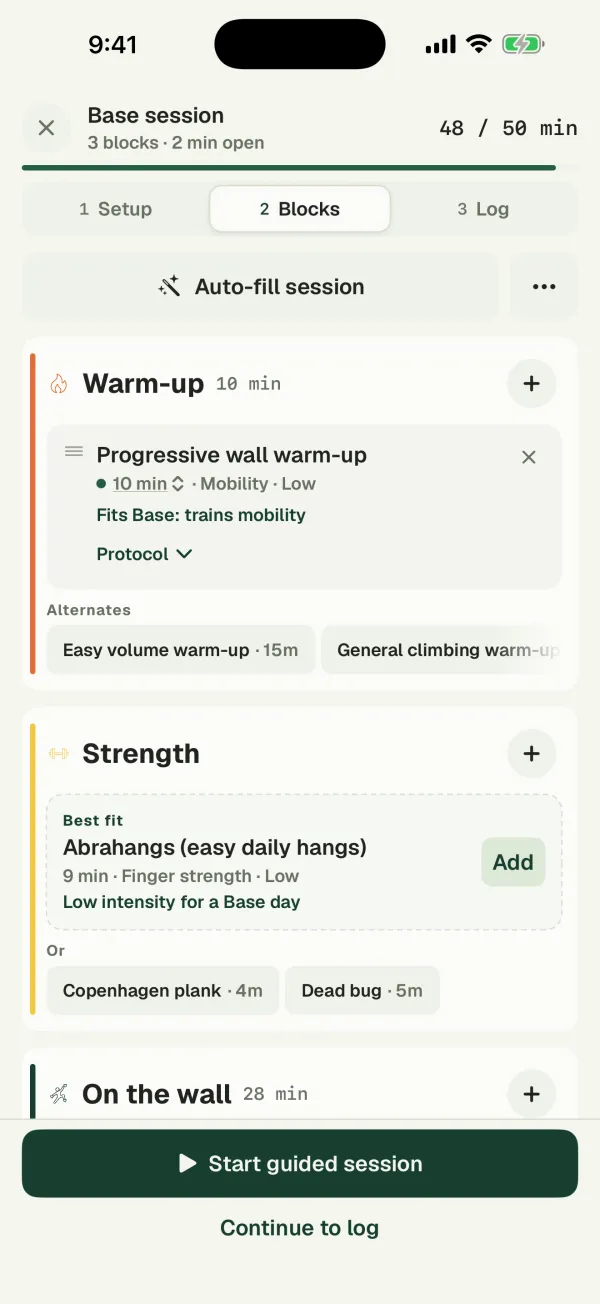
In Blok Sessions every session has a strength part next to the warm-up and the climbing, so 10 minutes of pushing and shoulder work goes into the session you're already doing.
Questions
Do push-ups count as antagonist training?
Yes. Push-ups, dips and overhead presses all work the pushing muscles. The plus at the top of a push-up also trains the muscle that holds your shoulder blade against your ribs when you reach.
Can I do antagonist training on a rest day?
Yes, it's light enough. Keep it to the same 10 minutes, so the rest day stays restful for your shoulders.
Does antagonist training prevent finger injuries?
Nobody has shown that. Finger opens against a band move your hand the other way and feel good after climbing. Protecting your pulleys comes down to how much hard finger work your week holds.
Before or after climbing?
The working sets go after climbing. A light round in your warm-up is fine, and the antagonist tissue prep is made for that.