How to train your fingers without hurting your pulleys
Keep most of it low-load and controlled. After a full warm-up, do easy feet-on hangs that never feel hard, or a few 10-second hangs on a 20 mm edge at moderate effort with 2 minutes rest, stopping while every hang still feels crisp. Add load in small steps, and only once a whole session felt controlled. Keep hard finger sessions at least 48 hours apart, and when finger training goes into your week, take some hard climbing out. Stop at pain in a finger. If a finger already hurts, see a physio before you train it.
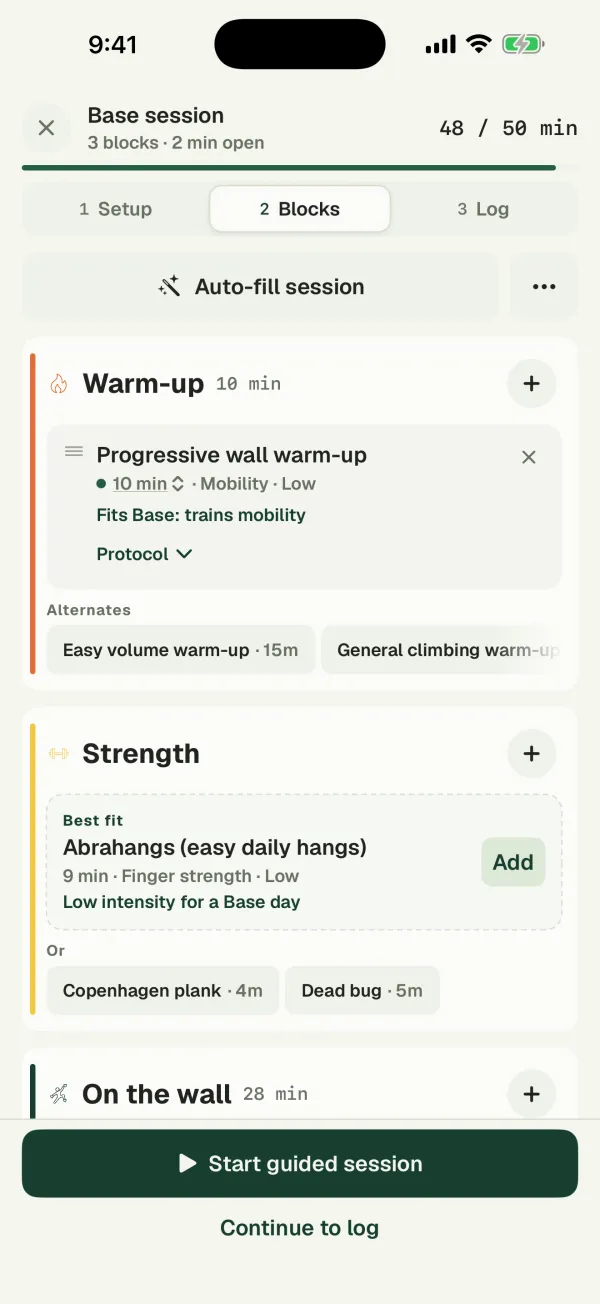
In Blok Sessions every exercise shows its minutes, intensity and injury risk, so you can build a session with low-load finger work after the warm-up and see the risk before you add anything harder.
Start with the free six-week strength plan: a file for the app and seven short emails on how to run it.
Or start planning in your browser with a free account.
“Why do I keep hurting my pulleys?”
When a finger tweak keeps coming back, look at the last few weeks before you blame one move. The pattern climbers describe again and again is total load: long sessions, lots of days at their limit, and hard hangs added on top of all the climbing they already did. The fix is rarely a special exercise. It’s how much hard finger work your week holds.
Two kinds of finger training
- Low-load, done often. Feet-on hangs like Abrahangs, where your hands hold only part of your weight, and finger rolls with a light dumbbell. They move your fingers through different positions and their full range without a max effort.
- Moderate hangs, a couple of times a week. Finger maintenance hangs on a 20 mm edge, well short of your max. Put a foot on a chair if you need to take weight off.
Max hangs and repeaters come later, if at all: for climbers with a year or two of regular climbing and no finger pain. If you’re newer than that, climbing lots of varied problems is already training your fingers, and you don’t need a hangboard yet.
Warm up your fingers, not just your body
Don’t do anything harder than the easy feet-on hangs cold. Before moderate or hard finger work:
- A few minutes of easy movement to get warm.
- Tendon glides to move your fingers through their full range.
- Easy climbing that gets a little harder each time.
- A few hangs that build up gradually and stay well below max, like the finger recruitment warm-up.
How to progress without a tweak
- Change one thing at a time: the load, the hang time or the edge size, never all three.
- Add load in small steps, and only after a whole session where every hang felt controlled.
- Keep the hand shape. If it changes during a hang, the load is too high.
- Leave a second or two in the tank. Hangs to failure are where your hand position falls apart.
- Plan lighter weeks. Every few weeks, cut the hard finger work and let things settle.
When finger training goes in, something comes out
Adding two hangboard sessions to four days of hard climbing gives your fingers more work, not better work. Before you add hangs, take out a hard climbing session or make one of them easy. Hard board sessions, limit bouldering and hangboarding all load the same fingers, so count them together.
When to stop
Stop the session straight away if you feel:
- sharp pain in a finger, or a pop
- pain that changes how you can hold on
- an ache or swelling that’s still there the next day
Then don’t keep training it and don’t try to fix it yourself. A rehab plan has to come from someone who has examined the finger: see a physio.
Who this isn’t for
Anyone with a finger injury right now. This page is about training healthy fingers, not coming back from a tweak. See a physio first, and follow what they give you.
The exercises
Abrahangs (easy daily hangs)
10 feet-on hangs of 10 s with 50 s rest, across six holds, from 70-80% down to 30-40% effort.
Finger rolls
3 rounds of 30 s slow finger rolls per hand with a light dumbbell, 30 s rest.
Tendon glides
3 rounds of 45 s cycling five hand shapes: straight, tabletop, straight fist, hook fist, full fist.
Finger recruitment warm-up
After easy climbing, 4-6 hangs of 5-10 s building to about 80% effort, 2 min rest.
Finger maintenance
After warming up, 5 hangs of 10 s on a 20 mm edge at moderate effort, 2 min rest.
Questions
Are Abrahangs easy on your pulleys?
They're low-load by design. Your feet stay on the floor, every hang is a share of the effort it would take to lift them, and it should never feel hard. That makes them a sensible way to train your fingers often. They aren't a rehab plan for an injured finger; for that, see a physio.
How often can I train my fingers?
Easy feet-on hangs can be daily, at least 6 hours away from climbing. Harder hangs, like max hangs, twice a week at most and 48 hours or more apart. Count hard board sessions and limit bouldering as finger training too, because they load the same fingers.
When can I start max hangs?
Once you've climbed regularly for at least a year or two, with no finger pain. Do them after a full warm-up, with a load that makes 10 seconds hard but clean, and stop at any sharp pain in a finger or elbow.
Half crimp or open hand?
Train more than one hand position. Keep the same shape for the whole hang, and if your fingers creep into a crimp on an open-hand hang, take weight off.
Can I hangboard with a sore finger?
No. A finger that hurts needs a physio to look at it, not a hangboard session. Train the rest of your body in the meantime, and ask the physio what climbing is fine.