
A bouldering training plan for climbers over 40
Keep the hard sessions hard and have fewer of them. Climb hard twice a week with at least two days between, add one short, easy session at home, and rest the other four days. Keep finger work at moderate load: 10-second hangs on a 20 mm edge that feel well short of your max, plus easy feet-on hangs on a rest day. Add 10 minutes of pushing and shoulder work twice a week. Plan the easy weeks in advance: two normal weeks, then a deload week with about half the hard work. When you're tired, cut volume before intensity.
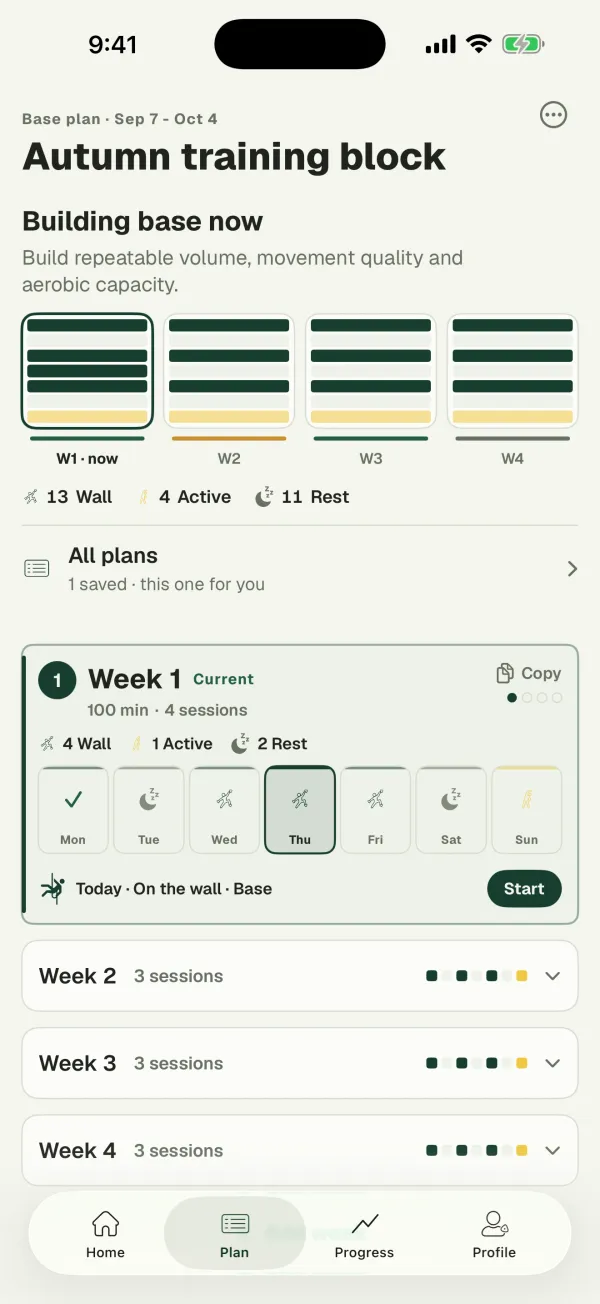
In Blok Sessions you lay out the weeks by hand, deload weeks included, and every exercise shows its intensity and injury risk before it goes in.
Start with the free six-week strength plan: a file for the app and seven short emails on how to run it.
Or start planning in your browser with a free account.
Keep it hard, keep it short
A common pattern, at any age but costlier after 40, is lots of medium sessions: climbing three or four times a week at an effort that’s never really hard and never really easy. It adds up to a lot of time on the wall and a lot of tired fingers, without the hard attempts that keep you strong.
The sample week does the opposite. There are two hard sessions, and they’re properly hard: limit problems, full rests, a cap on tries. The rest of the week is either easy or off. If you’ve spent years on three medium sessions, this will feel like training less, and you’ll probably climb better for it.
Why two days between hard sessions
Recovery is the thing that changes most in what climbers over 40 report: “at what point did you drop from 3 hard sessions” comes up in thread after thread. You can’t rush it, so the plan builds it in. Tuesday and Saturday leave two or three days between the hard work, and the one session in between is easy enough that it doesn’t eat into that.
Finger work at a load you can repeat
Two kinds of hangs are in the week, and neither is a max effort.
- On the hard day, a short set of hangs on a 20 mm edge at moderate load, right after the warm-up. Each hang should feel crisp. If it’s a fight, take weight off with a foot on a chair.
- On the easy day, Abrahangs: feet on the floor, effort well below what it takes to lift your feet. They should never feel hard, and they belong on a rest day or at least 6 hours away from climbing.
If you’ve done max hangs for years without trouble, you don’t have to drop them. Do them in place of the Tuesday hangs, not on top of them. They’re max intensity with a high injury risk: warm up fully, and stop at the first sign of pain in a finger or elbow.
Antagonists, twice a week
Climbing is all pulling. Ten minutes of pushing and shoulder work, twice a week, balances that out and it’s easy to fit in: after the Saturday session, and as most of the Thursday session at home. These are low-risk exercises with light bands and dumbbells, and they shouldn’t feel like a workout.
Plan the deload before you need it
Don’t wait until you’re wrecked. Put a deload week in the plan every third week before the block starts, so it happens on schedule:
- Weeks 1 and 2: the sample week as it is.
- Week 3: the same days, roughly half the hard work, easy climbing kept in.
- Repeat, and add a little load in week 4 only if weeks 1 and 2 felt good.
In Blok Sessions a deload week is its own training period, and every exercise says whether it’s meant for one, so the easy week doesn’t fill up with hard work by accident.
Who this isn’t for
Climbers coming back from an injury: see a physio first and follow their plan. And if you’re training for a trip or a comp, you’ll want a block that peaks. The structure here is for the long run: getting stronger without getting hurt.
The exercises
Finger maintenance
After warming up, 5 hangs of 10 s on a 20 mm edge at moderate effort, 2 min rest.
Abrahangs (easy daily hangs)
10 feet-on hangs of 10 s with 50 s rest, across six holds, from 70-80% down to 30-40% effort.
A sample week
Monday
Rest
Tuesday94 min
The hard day: moderate finger hangs while you're fresh, then harder problems with a cap on tries.
- Full warm-up (floor and wall)15 min
- Finger maintenance9 min
- Progressive ten60 min
- Forearm flush10 min
Wednesday
Rest
Thursday31 min
Easy, at home: low-load hangs and shoulder, wrist and pushing work. Nothing that leaves you tired.
Friday
Rest
Saturday88 min
Short and intense: a proper ramp-up, a few limit problems with long rests, then pushing.
- Progressive limit boulder ramp20 min
- Hard projecting60 min
- Pike push-ups8 min
Sunday
Rest. A walk or an easy ride is fine.
Questions
Should I stop doing max hangs after 40?
Not because of a birthday. Max hangs are max intensity with a high injury risk at any age, so if you do them, do them fresh, after a full warm-up with lighter hangs, and at most twice a week with 48 hours between. If a finger hurts right now, see a physio before you hangboard.
How many days a week should I train?
Start with two hard days and one easy one. Notice how your fingers and shoulders feel two days after each hard session. If you're still sore when the next one comes round, drop the easy day before you drop a hard one.
How often should I take a deload week?
Every third week is a good place to start. Plan it in before the block begins, so it happens even when you feel fine. Keep the same days, keep some climbing, and cut the hard work roughly in half.
Do I need a longer warm-up?
Many climbers over 40 find they do. Give it 15 to 20 minutes and build up to the moves and holds you're about to try, so the first hard attempt isn't a shock.
I climb 6B (V4). Is this plan too much?
The structure works at any grade; the grade changes which problems count as hard. If you haven't hangboarded before, start with the easy feet-on hangs only and add the 20 mm hangs after a few months of regular climbing.