
How to time 7/3 hangboard repeaters with rest between sets
Time them as sets, not as one long countdown. One set is 6 hangs of 7 seconds with 3 seconds off between them, which takes a minute. Rest 3 minutes after each set and do 5 sets, 17 minutes in all. So your timer needs three numbers: the 7-second hang, the 3-second break and the 3-minute rest after every sixth hang. If it only takes one rest time, you'll be counting sets in your head and starting a second timer for the long rest, which is exactly when people cut the rest short.
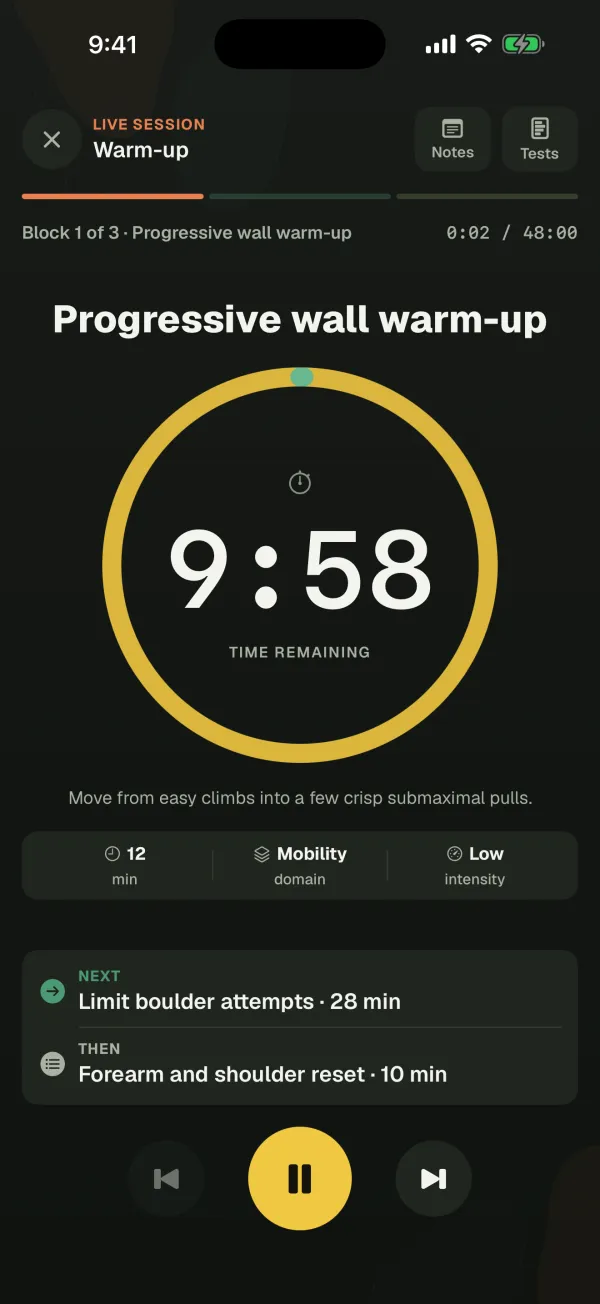
In Blok Sessions, 7/3 repeaters are one exercise with the hangs, the short breaks and the 3 minutes between sets built into the timer.
Start with the free six-week strength plan: a file for the app and seven short emails on how to run it.
Or start planning in your browser with a free account.
What one set looks like
| Hang | On | Off |
|---|---|---|
| 1 to 5 | 7 s each | 3 s each |
| 6 | 7 s | 3 minutes, then the next set |
Five sets of that is 30 hangs. The short breaks aren’t rest: stay under the board, shake out once and take the edge again. The long break is the rest, and it’s where the next set gets its quality.
Setting it up on an interval timer
Most interval timers ask for work, rest and rounds. For repeaters you need a fourth number:
- Work: 7 seconds
- Rest: 3 seconds
- Rounds per set: 6
- Rest between sets: 3 minutes
- Sets: 5
If your timer has no “rest between sets”, set 6 rounds, and start a separate 3-minute timer after each set. Write the set number down. Losing count on the fourth set is the most common reason people do four or six.
Where it goes wrong
- Shortening the long rest. Two minutes feels like enough after set one. By set four you’re hanging with a different hand shape and it’s no longer the exercise.
- Too much weight too soon. If the sixth hang of set one is already a fight, the remaining sets turn into an endurance test. Take weight off.
- Doing them cold. These are high intensity with a high injury risk. Do them after a full warm-up, including some easier hangs, and stop at the first sign of pain in a finger.
- Doing them tired. Put them early in the session, before hard bouldering, not after it.
Who shouldn’t do them yet
Climbers in their first year or two, and anyone with a sore finger right now. If a finger’s injured, see a physio before you hangboard. Easier, lower-load hangs like Abrahangs are a better starting point.
The exercises
Half-crimp 7/3 repeaters
5 sets of 6 x (7 s hang, 3 s off), 3 min rest between sets.
Open-hand 7/3 repeaters
5 sets of 6 x (7 s open-hand hang, 3 s off), 3 min rest between sets.
Questions
What does 7/3 mean?
7 seconds hanging, 3 seconds off the edge. Six of those make a one-minute set. It's sometimes written 7:3 or 7 on, 3 off.
Half crimp or open hand?
Both are worth training, so many climbers alternate them session to session. Pick the one you avoid on the wall. Keep the hand shape the same for all six hangs of a set; if your fingers creep into a crimp on an open-hand set, make it easier.
How much weight should I add?
Enough that the last hang of each set is hard but still clean. If you can't finish the fifth set, take weight off, with a foot on a chair or a pulley. Add weight only once all 5 sets feel clean.
How often can I do repeaters?
Once or twice a week is plenty, never on back-to-back days, and not on the same day as your hardest max hangs. They're high intensity with a high injury risk.
Can I shorten the 3-minute rest?
Not if you want the sets to be about strength. With a short rest the later sets turn into an endurance test and your hand position falls apart first.