
How to break a bouldering plateau without just training more
Find out what's limiting you before you add more training. Test your fingers with a short max hang on a 20 mm edge and your pulling with a heavy 2-rep pull-up, then look at your log: if nearly every boulder in it is a send, you're not spending enough time on climbs you can't do yet. Then change intensity, not volume. Put hard attempts first, rest at least 3 minutes between them, and stop when the moves get sloppy. If you climb hard most days and still feel flat, drop a session for four weeks.
Blok Sessions has five benchmark tests and a logbook with a grade pyramid and send rate by wall angle, so you can check your fingers, your pulling and your hard climbing before you change the plan.
Start with the free six-week strength plan: a file for the app and seven short emails on how to run it.
Or start planning in your browser with a free account.
Stuck at 6C (V5) for years: what’s actually limiting you
Most plateaus come down to one of four things. Check each before you change your training:
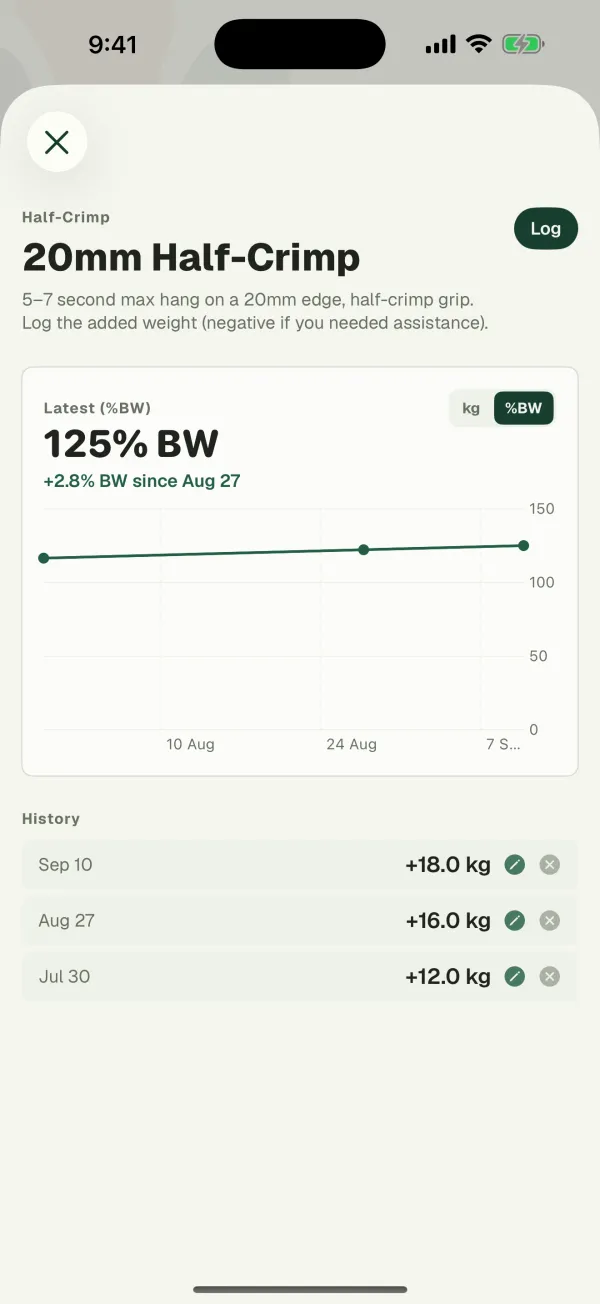
- Fingers. A short max hang on a 20 mm edge in a half crimp. Log the added weight, or how much you took off with a pulley.
- Pulling. The most weight you can add for 2 strict pull-ups from a dead hang.
- Movement. Film a few hard attempts and watch them straight away. Look for feet you readjust, hips far from the wall and moves you pulled through instead of pushing with your legs.
- How you spend your sessions. Look back at four weeks of your log. How many boulders did you try that you couldn’t do?
A test tells you where you are and whether you’re improving. It doesn’t tell you what to train on its own. Compare it with your own last result on the same edge, not with a friend’s on a different board.
“I train loads and nothing changes”
A common pattern: most of the session goes on grades you can already flash, a hard boulder gets a few goes, then it’s back to mileage. That’s volume, and more volume usually keeps you at the grade you already climb. To move up, spend more of each session at your limit:
- Hard climbing first, straight after the warm-up, while you’re fresh.
- Pick specific boulders at or just above your limit and go back to them every week.
- Rest properly between attempts, so each one is a real attempt and not a tired one.
- Decide what to change after every fall. Getting back on without a plan repeats the same fall.
- Stop when the quality drops. Sloppy attempts at your limit teach you sloppy moves.
Sometimes the fix is climbing less
If you climb hard four or five days a week, never feel fresh and your best session was weeks ago, the problem may be recovery. Take one session out for four weeks. Keep the hard days hard and make one of the others easy. Give it the full four weeks before you judge it.
Look for your weakest style
A plateau often hides in one style: slab, compression, small feet or wide moves. If your sends all look the same, spend one session a week on the style you avoid, and note what stopped you on each boulder.
Where it goes wrong
- Adding a hangboard on top of everything. When finger training goes in, some hard climbing has to come out, or your fingers just got more work.
- Changing five things at once. Then you won’t know what worked. Change one, then retest.
- Limit moves done cold. Short, hard moves at your limit carry a high injury risk. Do them after a full warm-up and stop at the first sign of pain in a finger or shoulder.
- Treating a send as the only measure. A move you couldn’t do last month is progress too.
Who this isn’t for
Climbers in their first year or two usually improve by climbing more, and more varied, problems. If a finger hurts right now, see a physio before you start trying hard again.
The exercises
Hard projecting
6 boulders at your limit, about 10 min each. At least 3 min rest between attempts.
Limit movement bite
3-4 hard single moves or 2-move links, 3-5 min rest between every attempt. Stop when quality drops.
Attempt analysis
After every fall, name what stopped you and pick one change before the next attempt.
Anti-style climbing
6 boulders in the style you're weakest at, 10 minutes on each. Note what stopped you.
Film and review
Film 3-4 hard attempts, watch each back, and pick one thing to change.
Questions
Is my plateau fingers or technique?
Test both. If your hang numbers keep going up and your grade doesn't, the limit is more likely movement or tactics, so film yourself and spend time on your weakest style. If the hang number hasn't moved in months either, finger strength is worth a few weeks of focused work, after a proper warm-up and with some hard climbing taken out to make room.
Should I climb on a board to break a plateau?
It helps if you go with a target, like a few problems near your limit with a set number of attempts and full rests. Scrolling through problems and trying whatever looks fun is volume. Keep some time on varied walls too, because a board won't teach you slab or the long moves of gym sets.
How many days a week should I climb?
There's no single right number, and how you use the days matters more than how many there are. Most climbers who train seriously manage three or four, with the hardest climbing on the days they're fresh. If you're always tired, one fewer day is the first thing to try.
How long before I see a change?
Give one change four to eight weeks, then retest the same way you tested before. Grades move slower than test numbers, so judge it by the tests and by how the hard moves feel, not by one send.