
A hangboard training plan for home
Hangboard twice a week at most, with two days between, and never the day before a hard climbing session. Warm up off the board for about 10 minutes, then do 5 hangs of 10 seconds on a 20 mm edge at a load that feels moderately hard, with 2 minutes rest, then a few pull-ups and push-ups. On the second day, do longer, lighter hangs: 30 seconds at moderate effort. Climb once in between, at the gym or on your home wall. Keep the same hangs for several weeks and only make them harder once every hang feels crisp.
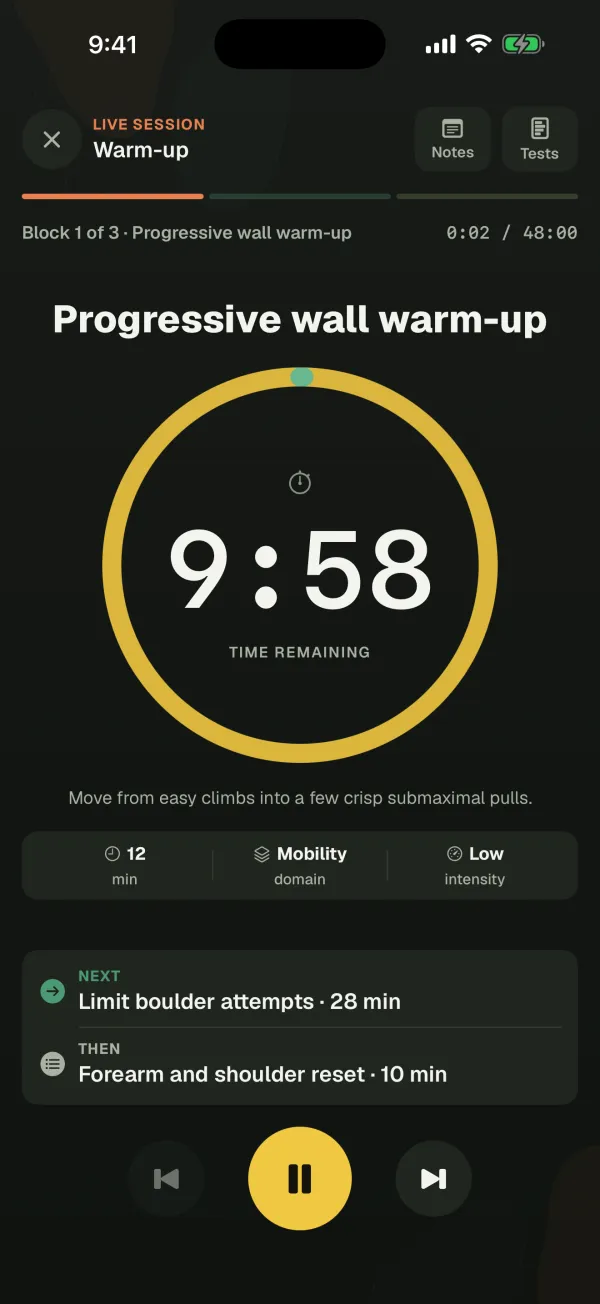
With Pro, Blok Sessions times every hang, rest and set, so the phone stays on the floor under the board.
Start with the free six-week strength plan: a file for the app and seven short emails on how to run it.
Or start planning in your browser with a free account.
You bought a hangboard. Now what?
“Homewall training tips” and “training at home” come up on climbing forums every month, and the story is usually the same: the board goes up, the first few sessions are enthusiastic and random, and a few weeks later it’s a place to hang a towel. What’s usually missing is a plan: what to do, on which day.
The sample week gives the hangboard two fixed days and gives climbing one, with rest days around all three. If you climb at the gym twice a week already, keep those sessions and use only the Tuesday and Saturday hangs.
Two kinds of hangs, two different days
The two hangboard days train the same fingers in different ways.
- Tuesday is short and strong. Five 10-second hangs with long rests. The load should feel moderately hard and every hang should be clean, with shoulders engaged and elbows slightly bent. It’s there to make you stronger without ever going near your max.
- Saturday is longer and lighter. Eight 30-second hangs, and you should finish each one knowing you could have held on for 10 seconds more. It builds time on the edge rather than peak strength.
Keeping them on separate days, with at least two days between, is what lets your fingers recover.
Warm up before the first hang
At home there’s no easy climbing to warm up on, so do it off the board: something that gets your heart rate up, arm, shoulder and wrist circles, then a few rounds of hand shapes. Before the first real hang, do two or three easier ones with a foot on a chair. The first hangs of the session are the ones that go wrong when you skip this.
When to make it harder
Keep the same hangs for several weeks. When every hang on Tuesday feels crisp and controlled, add load in small steps, or move on:
- 7/3 repeaters in place of the Saturday hangs.
- Max hangs in place of the Tuesday hangs.
Change one day at a time. Both are high injury risk: warm up fully, and stop at the first sign of pain in a finger.
If you have a home wall
Use it for Thursday. A home wall is great for setting short problems around one thing you’re bad at, like lock-offs, bad feet or wide moves, and climbing them a few times each. The one rule: rest between attempts as you would at the gym. On a home wall it’s easy to keep pulling on the same problem with 30 seconds between goes, and then it’s a pump session.
What goes wrong
- Hangboarding on top of everything. A full hangboard session the night before a hard gym session means both are done tired.
- Chasing a harder edge every session. The load goes up when the hangs are easy, not when you feel like it.
- No rest timer. Two minutes feels long at home, so it turns into 45 seconds. Time the rests.
Who this isn’t for
Climbers in their first year: climbing is still the best finger training you can do. And if a finger hurts right now, see a physio before you hang on anything.
The exercises
Finger maintenance
After warming up, 5 hangs of 10 s on a 20 mm edge at moderate effort, 2 min rest.
Long-duration density hangs
8 hangs of 30 s at moderate effort, 2 min rest.
A sample week
Monday
Rest
Tuesday37 min
Hangboard at home: warm up off the board, short moderate hangs, then pulling and pushing.
- General warm-up10 min
- Tendon glides3 min
- Finger maintenance9 min
- Pulling maintenance10 min
- Push-up plus5 min
Wednesday
Rest
Thursday70 min
On the wall, at the gym or on your home wall: a movement warm-up, problems set around one weakness, then a hold-removal game.
- Movement quality warm-up15 min
- Board weakness setter35 min
- -120 min
Friday
Rest
Saturday31 min
Hangboard at home: longer, lighter hangs, then shoulders and core.
- Tendon glides3 min
- Long-duration density hangs18 min
- Wall angel hold5 min
- Dead bug5 min
Sunday
Rest
Questions
Can I hangboard before I climb?
A few short, easy hangs as part of a warm-up, yes. A full hangboard session, no. Keep it to 3 or 4 hangs before the wall, or give the hangboard its own day, like the sample week does.
What if I can't hang 10 seconds on 20 mm?
Take weight off. Put a foot on a chair, or use a pulley with a counterweight, until 10 seconds feels moderately hard. Feet-on hangs like Abrahangs are another good place to start.
When should I start max hangs or repeaters?
When the moderate hangs have felt easy for several weeks, and you've climbed regularly for at least a year or two. Both are high injury risk. Change one session at a time, never both.
Do I need Pro for this plan?
No. The plan, the exercises with their sets and rest, and the logbook are free. Pro adds guided sessions, which time each hang and rest for you, and the plan generator. Pro is €2.99 a month, €14.99 a year or €24.99 once.
I don't have a pull-up bar. What then?
Use the big jugs on your hangboard for the pull-ups, if it has them. If not, skip the pulling and keep the push-ups: the hangs are the part that matters.