
When to start campus board training without hurting your fingers
Later than most climbers think. No study sets a starting point, so use a checklist: two to three years of regular climbing, no finger or elbow pain right now, hard limit bouldering already in your week, and done growing. One standard some coaches use is a one-arm hang on a 20 mm edge for 20 seconds, three times. Below about 7A (V6), limit bouldering and feet-on power drills give you most of what campusing would. When you start, keep your feet on, campus once a week in a power block after a full warm-up, and stop at any pain.
“Do I need to start using a campus board?”
Probably not yet. Campusing is moving between rungs on your fingers alone, and it’s one of the hardest loads you can put on your finger tendons and your elbows. Tendons and ligaments adapt more slowly than muscle, so you can have the strength for a campus move well before your fingers are ready to repeat it week after week.
Coaches usually put campusing late, after years of climbing and some finger training. That’s coaching experience. No study has tested when it’s safe to start.
The checklist
Tick every line before your first session:
- Two to three years of regular climbing, with some finger training already behind you.
- No pain in a finger or an elbow right now.
- Limit bouldering is already a regular part of your week.
- You’re past your growth spurt. Teenagers who are still growing should get their power from hard climbing.
- A strength standard. One that some coaches use is a one-arm hang on a 20 mm edge for 20 seconds, three times. And if one pull-up is your max, real campus moves aren’t possible yet.
What to do until then
Campusing trains fast pulling and catching a hold hard the moment you touch it. You can train most of that with your feet on the wall:
- Limit bouldering: the first one or two moves of boulders harder than your project.
- Deadpoints, catching an exact spot on the hold at the top of the move.
- No-impact dynos, where you touch the target and let go before you weight it, and powerslaps.
- Explosive pull-ups, for pulling speed on a bar.
For most climbers below about 7A (V6), these and hard bouldering cover it. The free four-week power plans at /plans are built from exercises like these and leave campusing out.
Your first campus sessions
Once you’ve ticked the list:
- Warm up fully: easy climbing, then harder boulders, then a few fast moves on big holds, like the contact strength primer.
- Keep your feet on to start. The campus ladder and contact hits both work with your feet on.
- Use the biggest rungs, and go footless with big-rung campus power only after weeks of feet-on sessions with nothing sore.
- Keep it short and early in the session. A common ratio is about a minute of campusing for every 5 minutes of bouldering.
- Put it in a power block of a few weeks, and take it out again afterwards.
Every campus exercise carries a high injury risk. Warm up fully, and stop the session at the first sharp pain in a finger or an elbow. If it’s still there the next day, see a physio.
Who shouldn’t campus
- Anyone with a finger or elbow injury right now. See a physio.
- Newer climbers, whatever grade they climb. Strong beginners often have the pull for campus moves years before their fingers are ready for them.
- Many coaches leave campusing out for climbers over 40 and keep their power work feet-on.
The exercises
First moves on too-hard boulders
Only the first 1-2 moves of 4 boulders above your project grade, max 3 attempts each.
Deadpoint training
3-4 moves, 5 tries each: deadpoint to an exact spot on the hold, feet staying on.
No-impact dynos
3 dyno set-ups, 5 jumps each: touch the target, let go before weighting it. 30 s between jumps.
Explosive pull-ups
5 sets of 3 pull-ups as fast and high as you can, 2-3 min rest.
Campus ladder
6 sets of 2-3 min feet-on laddering up and down, rest as long as you climbed.
Big-rung campus power
4-5 footless campus ladders on big rungs, 3 min rest. Stop as soon as speed drops.
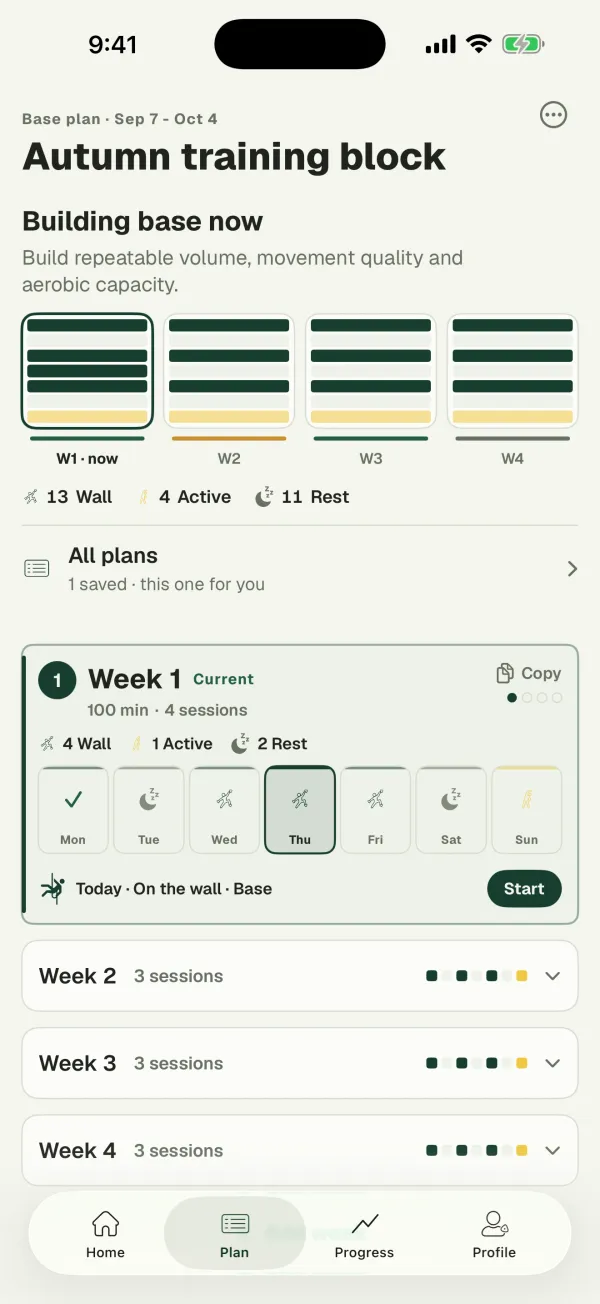
In Blok Sessions every exercise shows its injury risk, with every campus exercise marked high, and you lay out your weeks in training periods, so campusing only goes into a Power block you planned.
Questions
Can I start campusing if I climb 6C (V5)?
You can, but you'll get more from limit bouldering and feet-on power drills. Grade alone isn't the test. Go through the checklist, and if you've climbed for less than two years, wait.
Does campusing prevent finger injuries?
Nothing shows that it does. Campusing loads your fingers harder than almost anything else you do, so treat it as a risk to manage.
Is footless bouldering the same as campusing?
Close enough to count. Steep boulders on big holds without your feet load your fingers and shoulders in a similar way, so the same checklist and the same safety rules apply.
How often should I campus?
Once a week to start, twice at most, and only in a power block of a few weeks. Do it early in a session while you're fresh, never at the end or on a tired day.